
TICKETS FROM
11,79 €
VISITOR RATING
4.8 (+26.900)
OPENING HOURS
9:00 – 17:00
DURATION
45 – 60 min
Matthias Church (officially the Church of the Assumption at Buda Castle) is the most iconic landmark on the Buda side of the Danube. With 700 years of history, a Zsolnay-tiled roof that’s unique in Europe, and an entirely hand-painted interior, it’s a must-see in Budapest. Below you’ll find all ticket options, updated hours, and tips for planning your visit.
Tickets for Matthias Church: Ticket Types and Prices
Six ways to visit Matthias Church. We explain what each option includes and which one best suits your trip.

Standard admission to the Church of Matías
11,79 EUR
BEST-SELLER
Entrance to the Church + Matías Tower
27,21 EUR
FREE CANCELLATION
Admission to the Church of Matías with Free Cancellation
22 EUR
VISITING BUDAPEST FOR MORE THAN A DAY?
Budapest Card · from €53
The 72h Plus option includes admission to St. Matthias Church + unlimited transportation + a Danube river cruise + 30 attractions + the Buda Castle funicular + airport transfer.
Matías Church Hours
Monday to Friday
9:00 – 17:00 h
Saturday
9:00 – 12:00 h
Sunday
13:15 – 17:00 h
*On Sundays in August, the site opens at 12:15 p.m. The reduced hours on Saturdays and Sundays are due to religious services. During Masses, access for tourists is suspended.
⚠ The church may occasionally close for events or ceremonies. If you plan to visit on a specific date, check the official calendar before you go.
How long does it take to visit the church?
Allow about 45 minutes for a leisurely visit to the church—take your time, but don’t stop at every information panel.
- Just the church: 45 minutes is enough to tour the interior, see the frescoes and the museum of sacred art, and leave without feeling rushed
- Church + Tower: Add 20–30 minutes for the climb and the views from the top
- With a guided tour: the tour lasts 2 hours and 30 minutes and also includes the Fishermen’s Bastion
The best hour to visit
For the best visual experience: the last hour before closing on sunny days. The evening light streams through the stained-glass windows and is cast upon the frescoes and the stone floor.
To avoid crowds: on weekdays, before 10 a.m. or after 3 p.m. Most of the traffic from organized groups occurs between 10 a.m. and 1 p.m. Sundays are the busiest days, partly because the hours are shorter (only 4 hours in the afternoon).
What to See at the Church of San Matías: What You Can’t Miss
The Zsolnay Tile Roof
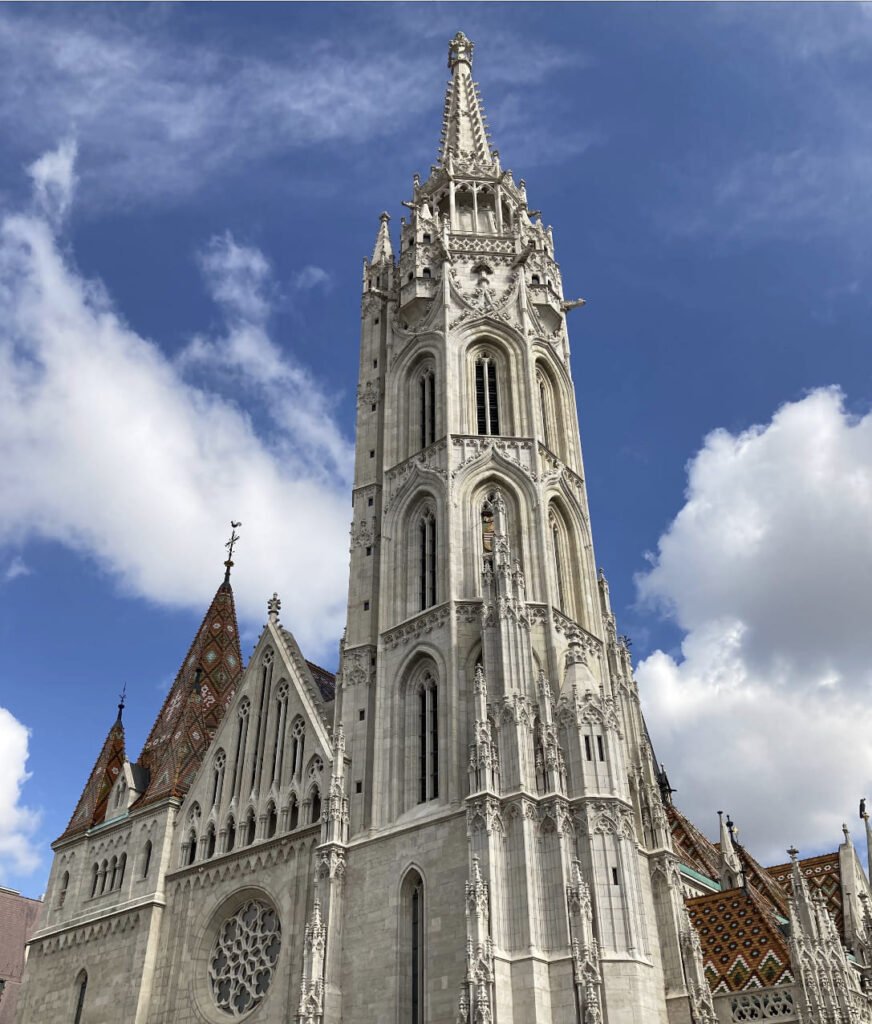
The tour begins at Plaza de la Santísima Trinidad, where you can admire the spectacular Neo-Gothic façade.
The first thing that will catch your eye is the roof, covered with more than 150,000 green, yellow, and black diamond-shaped pyrogranite tiles, manufactured by the renowned Zsolnay factory in Pécs, Hungary.
Pyrogranite is a type of ceramic developed in Hungary in the 19th century. Its use became widespread throughout Budapest’s architecture, so you can find it on other buildings in the city, such as the National Archives and the Central Market.
Matías Tower: Is it worth the climb?
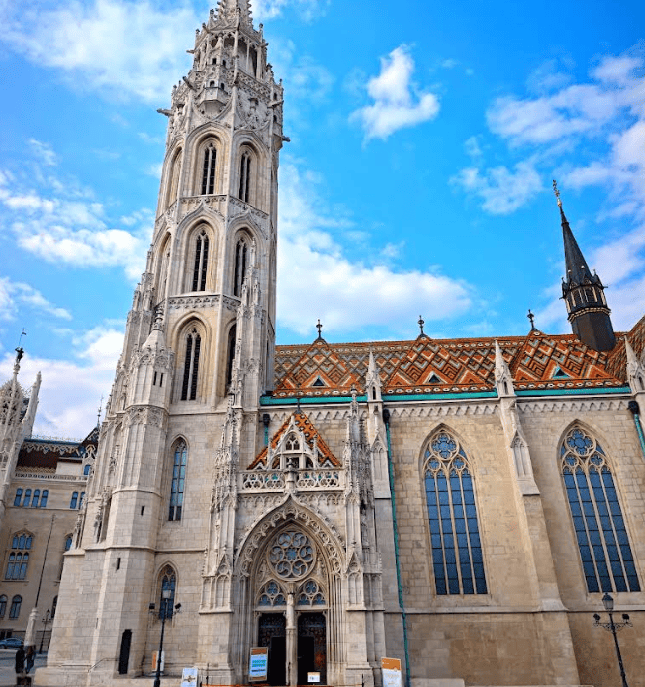
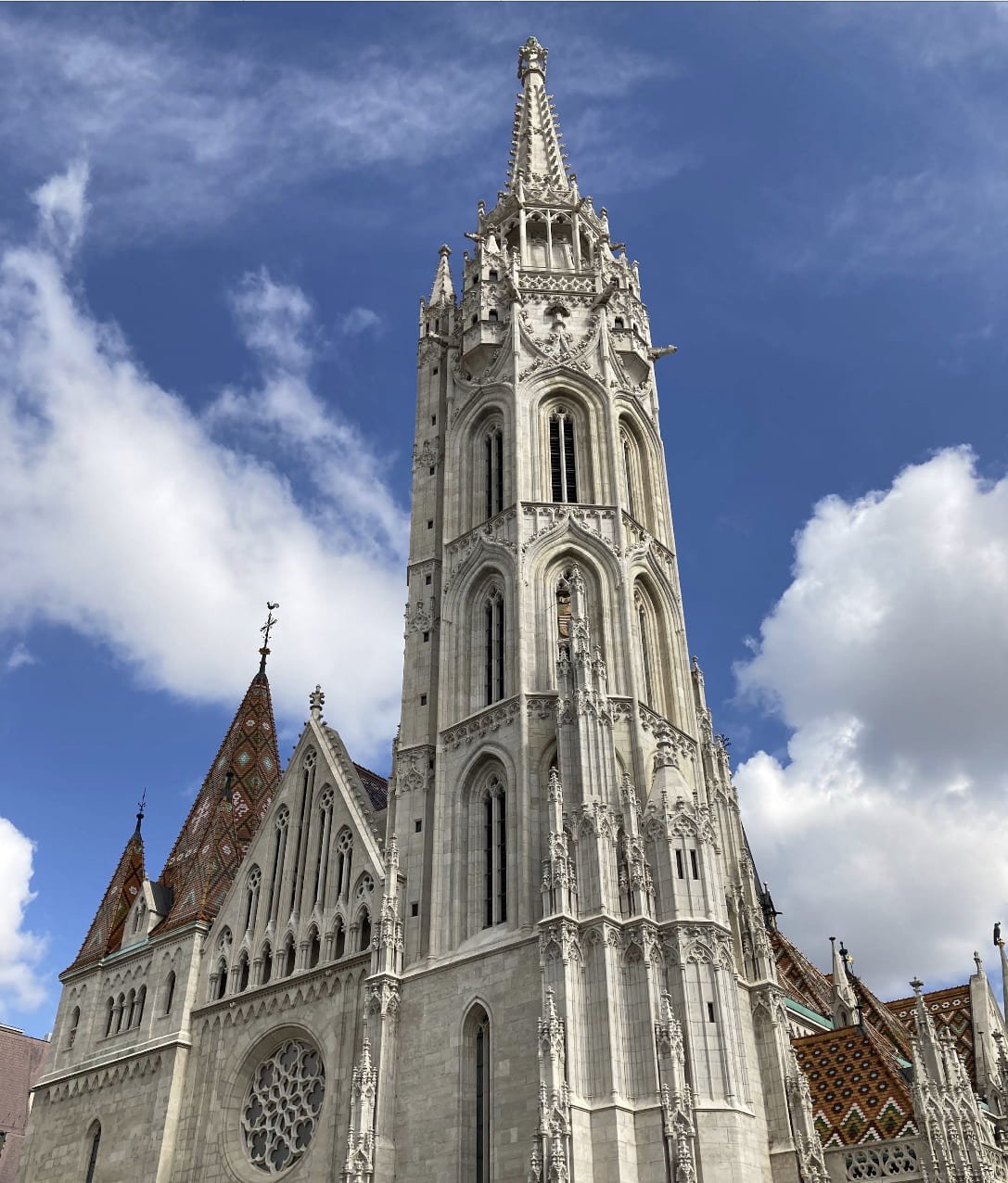
At 78 meters tall, the Matthias Tower is the tallest structure on the entire Buda Castle Hill.
At the top, you’ll see a sculpture of a raven with a gold ring in its beak. Legend has it that the raven stole the gold ring from King Matthias, who pursued it until he recovered the ring and adopted the bird as a symbol of good luck. The raven with the ring became the heraldic symbol of the Hunyadi dynasty and appears repeatedly on coats of arms and ornaments throughout the church.
The tower has 5 floors, and visitors climb a spiral staircase with 197 steps to reach the top. There is no elevator.
When you reach the top, a spectacular 360-degree panoramic view awaits you, stretching from the Fishermen’s Bastion, past the Hungarian Parliament Building, the Danube River, and its famous bridges, all the way to Gellért Hill.
⚠ Access to the tower is not included in the basic admission ticket. You’ll need the Church + Tower ticket (€27.21). If you’re planning to go up, it’s cheaper to buy it right from the start.
The interior: cool, stained-glass windows, and the museum of sacred art
The entrance is through the Gate of the Virgin Mary, a 14th-century Gothic portal considered one of Hungary’s best-preserved medieval relics. The original relief depicts the Dormition of the Virgin.
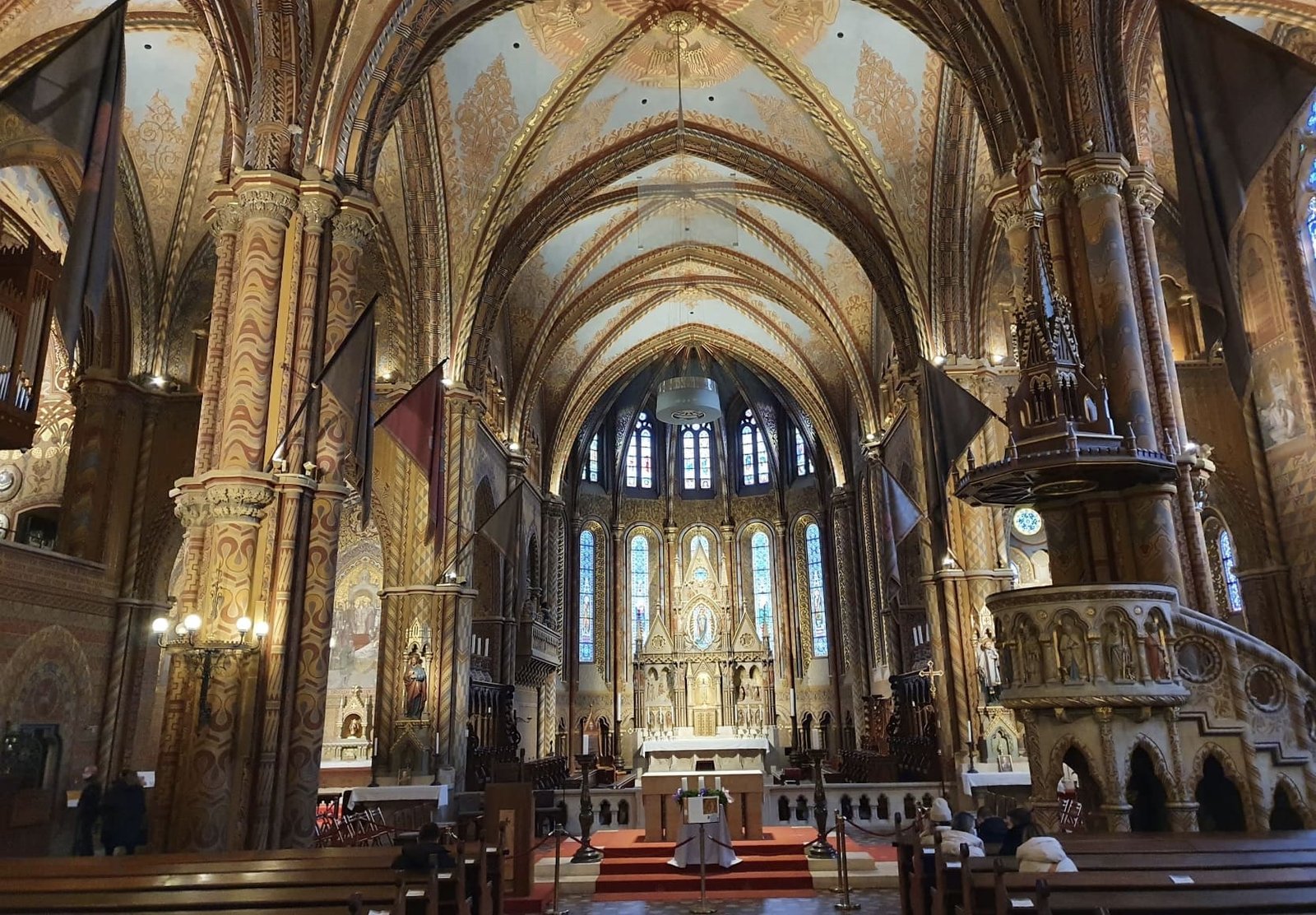
As you walk through the doors, you’ll step into a church that breaks with the traditional Gothic style of exposed stone interiors. Absolutely every surface is hand-painted—columns, arches, vaults, and walls—leaving not a single centimeter undecorated.
The painters Károly Lotz and Bertalan Székely drew inspiration from ancient Hungarian temples and Byzantine art, using geometric and floral motifs that recur and evolve throughout the nave.
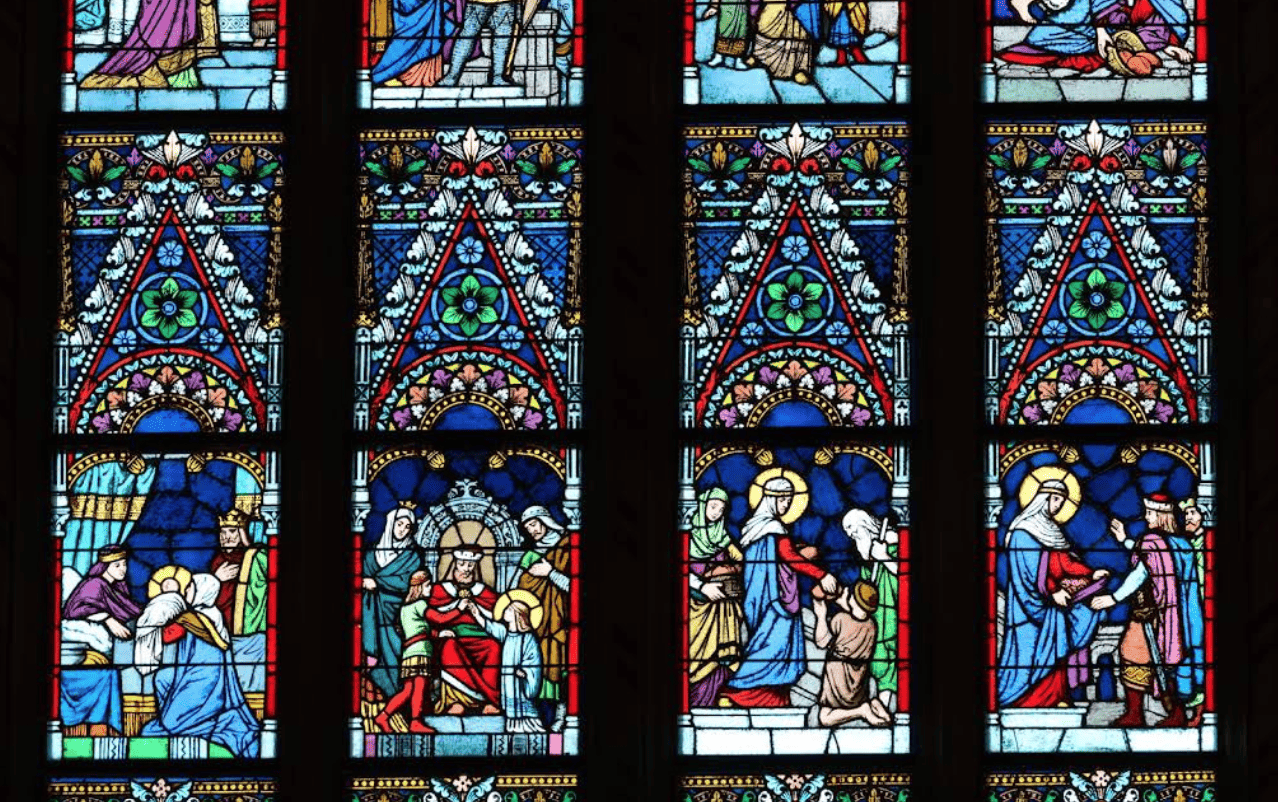
At the back of the main nave, the altar pays homage to the Virgin Mary. Behind the altar, the stained-glass windows filter the natural light and cast it onto the floor and walls, creating a multicolored light show.
To the left of the nave is the Chapel of the Holy Trinity. This chapel houses the remains of King Béla III of Hungary and his wife, Anne of Antioch. It is one of the few visible medieval royal burial sites in Hungary.
The tour leads from the main hall up to the Royal Chapel on the upper floor. This space was built exclusively for the royal family. On display here is a replica of the Hungarian Crown Jewels, which includes the scepter, the royal orb, and the Crown of St. Stephen; the originals are kept under heavy guard at the Hungarian Parliament in Budapest. This is the only way to see them up close.
From the first-floor galleries, you can enjoy the best views of the interior of the temple. You’ll also find the Chapel of the Knights of Malta, featuring the coats of arms of deceased knights—a tradition that continues to this day.
History of the Church of Matías
Its official name is the Church of the Assumption at Buda Castle, although almost no one calls it that. The nickname “Matthias Church” is a popular tribute to the king who renovated it in the 15th century and celebrated his two royal weddings there.
The Church of St. Matthias has survived an Ottoman conquest—a documented miracle—two imperial coronations, and a siege that left it in ruins. What you see today is the result of seven centuries of destruction, reconstruction, and reinvention.
How to get to the Church of Matías
Bus Line 16
Get off at the Szentháromság tér stop, right across from the church. It’s the easiest and fastest way to get there from Pest. Trains run every 10 minutes.
Walking
If you’re walking from Pest, cross the Chain Bridge to Buda and climb the stairs to the Fisherman’s Bastion. The walk takes about 20 minutes from the bridge.
Buda Castle Funicular:
Take the historic funicular up Buda Castle Hill and enjoy the spectacular views of the Danube and the Pest side of the city.